Tuesday, August 25, 2009

Wednesday, July 8, 2009
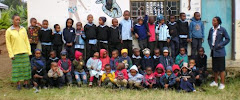
kisongo accademic college ,tour with judit hagner from german last year in june,july...


Monday, June 22, 2009
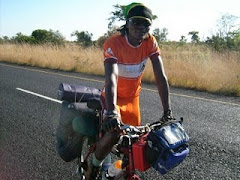
LEAVING HIS FAMILY....STEP OUTSIDE THE DOOR ...HE IS IN THE ROAD CYCLING AROUND AFRICA WITH DESTINATION TO JOHANESBURG S. A.. ....AMAZING!


I leftArusha 9:30am friday 5 June.It was raing whwn we left the predicted point of half way from Caaro
Thirty kilomoter from clock tower the tarmac road end up and I started to cycle through rough road. I passed through few Maasai villages and comiphora-acacia bush land which covered most of the part.Half of the way was down slope and terrran. Another half was sand, escapment and up hills such Komolo hills.
In this savanah plains/bushland is heaven of of birds. In the edge of mountains I saw baboons and dick. I enjoy the tranquel and calmness of the area as I cycle for long time before meet any one in the road. sometime I had the seen of fear but the cow bell from the bush give me hope that I'm not alone.
I arived at the Nabikito village 6:30pm. Here I went to the certain boma and asked the elder man for the parmition to camp within his large tertory. As he knew some one like me I was in this need he gave the pamition. I liked the place for some reason some I'll write letter but one is that; Maasai huts doe not have much defferent with my tent.
In the next day I left Maasai boma 7:00am bit late for me this is because I was forced to wait for fresh milk from cow. Maasai mama told me is not good to let some body who is going for such long jorney leave without some ernegy drink such as milk. The elder man wanted to give me fresh blood but I aploguse for that.
It was nice riding through this bit high alevation bush land with some plain where i was able to see Zebras, Ostrichs, Wildbeests and gazelles. As i was enjoying this wonderfull moment unkind tsetse flys force me to leave the place. Thanks for them because I stll have couple of kilomiters aheard of me. In this day riding was more challenge up hills rocks and sand was limit my spead to 10km/hr. I passed Naberera village and Namalulu where I had wonderfull and breath taking landscape. At 6:00pm I arive at Engasumenti villange after 2hours of up hill climbing. Here I camp at police station.
In the next day early in the morning i left engasumente village which situated in the top of the hill, inhabited by Maasai pastoralist. Here the town start to show the sign as I can saw some shops and other services imegide in this Simanjiro district in new Manyara region. I discent the town where it was 10c very cold. cycled throuh the plains with the enjoyable speed of 25km/hr. in the other places road is very sand whereby I had to push my havy louded bicycle. The road is very long stretch as far as my eyes can see. It is very hot more than 3hrs without meet any one. I felt like bushes and birds used to talk and now they talking about this strenger with his bicycle. When i met Maasai, they are in the group and ecuped with spears here i had the seens of dager in this plains. Theis Maasai stoped and start wonder about me speach less. After 70km I made to Ndedo village the first village since I started to cycle in the morning. I went to the shop for drinks.As shopekeper offer me a drink he i saw the sign of fear in his face at lat he asked me, "where are going my friend?" I told him I'm going to Kibaya Kiteto. He said "You shoud be crayze!"He told me where I come from in the certain hill there is one Maasai killed by lions few days ago. He add that where I'm I'm going it is more dangerous. As we was talking a lory which was delivare drinks to Kibaya came. The man run out from his shoop and stoped the lory. He talk with lory drive something which I couldn't hear but as I sow lory looded at me I gessed the man asked the the lory drive to give me free ride. After few minutes the man come back and told me "Brother it's better you cross this plains with this lory, the drive is okey. I ride with the lory up to Kibaya Kiteto where I reached in the everning.
At kibaya Kiteto I overninght at Riverine Hotel where the owner, certain woman offered me free accomodation.
In the next day 6:30am I start riding, climbed the the up hills then decent to the plains. The road was very nice whereby I cycled for 25 to 35km/hr. I climbed Dosidosi hills (1819m), passed through chains of villages. The road was very nice. I manege to cycle for 35-40km/hr. At 2:47pm I met the high way from Morogoro to
The road from Mtera to Iringa It's not good for bicycle such as my which is heavy louded. due to this and some roumers that there are some roberers in the vertain mountain. This might not be good for sole ride to pass alone. I asked free ride from Electricsal Company lory drive who agree to ride me up to Iringa town. I arrive in Iringa town 7:00pm. I overnight at the guest house. I left guest house in the morning, cycled to town where I found the internet. Here is where I post this article.
After Maasai Steppe and semi-desert of central
Tuesday, May 12, 2009
LETS DEVELOP THE HABIT TO READ MY FELLOWS.......
Its obviously that it wont be the first time to you to hear that saying,it has been used for so many years as a means of discrediting Africans.
When you try to examine what is real within that phrase of words, you will come up with the conclusion that most of Africans do not like to read the books,but if we knew it we could have ran to libraries to open the books so that we can enjoy the intercourse with superior minds. The president of United States of America Barrack Obama has benefited form the practice of consulting the books and in his witness he said that “I thank the books because they opened my mind”....and I think that is why he is the leading speech maker in the world as most of his speeches has been ranked as the best speeches.
Most of us and especially students in higher learning institutions in Tanzania are somehow narrow minded because of our behaviors of not reading the books and we are used to “madesas” given by our tutors and lecturers....and we misses extra knowledges obtained in the books and that is why we fails in making some analyses to some important aspects of life. Also we fails to make relevant references to our arguments in our normal life and we are the same as laymen when it comes to analysis of different life phenomenas.
I here come before you to urge you that books are the best places we can enjoy the pool of knowledges and precious thoughts.
It is chiefly through books that we enjoy intercourse with superior minds. In the best books,great men talk to us,give us their most precious thoughts, and pour their souls into ours. God be thanked for books. They are voices of the distant and the dead, and make us heirs of the spiritual life of past ages. Books are true levelers. They give all who will faithfully use them, the society, the spiritual presence of the best and greatest race.
Source:vyuotz.blogspot.com
When you try to examine what is real within that phrase of words, you will come up with the conclusion that most of Africans do not like to read the books,but if we knew it we could have ran to libraries to open the books so that we can enjoy the intercourse with superior minds. The president of United States of America Barrack Obama has benefited form the practice of consulting the books and in his witness he said that “I thank the books because they opened my mind”....and I think that is why he is the leading speech maker in the world as most of his speeches has been ranked as the best speeches.
Most of us and especially students in higher learning institutions in Tanzania are somehow narrow minded because of our behaviors of not reading the books and we are used to “madesas” given by our tutors and lecturers....and we misses extra knowledges obtained in the books and that is why we fails in making some analyses to some important aspects of life. Also we fails to make relevant references to our arguments in our normal life and we are the same as laymen when it comes to analysis of different life phenomenas.
I here come before you to urge you that books are the best places we can enjoy the pool of knowledges and precious thoughts.
It is chiefly through books that we enjoy intercourse with superior minds. In the best books,great men talk to us,give us their most precious thoughts, and pour their souls into ours. God be thanked for books. They are voices of the distant and the dead, and make us heirs of the spiritual life of past ages. Books are true levelers. They give all who will faithfully use them, the society, the spiritual presence of the best and greatest race.
Source:vyuotz.blogspot.com
Wednesday, April 29, 2009
THIS IS ALL ABOUT TRAVEL......
So travel is above all a stimulant for the brain. A mind tonic. A soul revitaliserTravel offers a repite from serious life citizenship....forget the mortgage, weeding the garden, feeding the cat and how much fibre you have in your diet. Just go. Free at last, if only for three weeks.Travel also provides soul food for those who journey. The image we have are given of the world by the media is often of despair and destruction. But to travel is to stumble across scene after scene of such rugged splendour and timeless magnificence that your emotions overwhelm your senses. If this place exists then there is hope yet for the world.To travel is to explore the many shadows of your psyche, for different people find beauty in different things....soul food comes in different packages.The magic of travel is everywhere. The tragedy, the drama, the pathos of past human life haunts every grand ruin, and you feel the haunted or triumphant ghosts echoing in your every step.Travel renews your sense of childlike wonder because the world indeed has many wonders. Sometimes wonder can be found on a small scale, a universe reflected on a drop of dew. Sometimes wonder is seen on a spectacular scale. To stand and absorb the massive prehistoric form of a mountain, is to feel for a moment like a mere speck of existence in the infinite continuum of the universe. To be humbled.And to travel is to experience irony. The boredom on the face of the gondolier in Venice. A cleaner yawning as they sweep the floor of the Louvre
Source.http://www.zionafrikasafaris.blogspot.com
Thursday, December 4, 2008
PAUL SWEEZY AND MAURICE DOBB DEBATE ON TRANSITION FROM FEUDALISM TO CAPITALISM
I've been promising some content here of a very different type than what I've posted so far. So here goes.
Recently I read the main documents in the Dobb-Sweezy debate on the transition from feudalism to capitalism. I wanted to open up discussion here on this if anyone is interested. From a Marxist perspective it's important to understand how feudalism fell, and the nature of the transition from feudalism to capitalism, in order to gain some potential insight into how capitalism will fall and what some of the important questions are in the transition from capitalism to socialism.
The main documents in the debate that I read are Maurice Dobb's The Decline of Feudalism and the Growth of Towns in Studies in the Development of Capitalism (1946), and Paul Sweezy's Critique of Dobb in The Transition from Feudalism to Capitalism, ed. R.H. Hilton (1976). Then there is Dobb's A Reply and A Further Comment and Sweezy's A Rejoinder, which are also in The Transition from Feudalism to Capitalism.
In this debate a main point of contention is between Dobb's attempt to demonstrate that capitalism emerged from contradictions internal to feudalism itself; while Sweezy more takes the position that capitalism developed independently of feudalism and overtook it as an external force because of its dynamism in contrast to feudalism's stagnancy. They also debate over what exactly defines feudalism. Dobb says that feudalism is essentially defined by the existence of serfdom. Sweezy says this definition is inadequate and that it may apply to Western European feudalism but shouldn't be generalized beyond that, as he accuses Dobb of doing.
Sweezy also raises the point that serfdom was ended in England in the 1500s, but feudalism didn't end until 1644-1645 - so how can Dobb explain that and how does he characterize that period in between. They disagree about how to characterize the period of the 1500's and 1600's in Western Europe, during the transition from feudalism to capitalism. Sweezy calls that period pre-capitalist commodity production. Dobb defines it as feudalism in an advanced state of dissolution.
Of course there is more to both of their arguments than this over-simplified summary, and I may have even unintentionally mischaracterized their positions in this quick recap. But I think this gets at some of the biggest points of contention between them. They both claim to be analyzing this history from a Marxist perspective, but come to different conclusions about the transition from feudalism to capitalism.
While reading these essays, I thought that both made some good points and at times I found myself convinced by things both of them said. But as someone who has studied Mao Zedong's essay On Contradiction a great deal, I found myself being pulled toward Dobb's argument that capitalism developed from contradictions internal to feudualism. It is a key point of Marxist philosophy (of dialectical and historical materialism), which Mao explains brilliantly in On Contradiction, that the primary basis of contradiction is internal.
In On Contradiction, Mao writes:
As opposed to the metaphysical world outlook, the world outlook of materialist dialectics holds that in order to understand the development of a thing we should study it internally and in its relations with other things; in other words, the development of things should be seen as their internal and necessary self-movement, while each thing in its movement is interrelated with and interacts on the things around it. The fundamental cause of the development of a thing is not external but internal; it lies in the contradictoriness within the thing. There is internal contradiction in every single thing, hence its motion and development. Contradictoriness within a thing is the fundamental cause of its development, while its interrelations and interactions with other things are secondary causes. Thus materialist dialectics effectively combats the theory of external causes, or of an external motive force, advanced by metaphysical mechanical materialism and vulgar evolutionism. It is evident that purely external causes can only give rise to mechanical motion, that is, to changes in scale or quantity, but cannot explain why things differ qualitatively in thousands of ways and why one thing changes into another.
Mao also writes:
Changes in society are due chiefly to the development of the internal contradictions in society, that is, the contradiction between the productive forces and the relations of production, the contradiction between classes and the contradiction between the old and the new; it is the development of these contradictions that pushes society forward and gives the impetus for the supersession of the old society by the new. Does materialist dialectics exdude external causes? Not at all. It holds that external causes are the condition of change and internal causes are the basis of change, and that external causes become operative through internal causes. In a suitable temperature an egg changes into a chicken, but no temperature can change a stone into a chicken, because each has a different basis.
From those quotes one could guess where Mao would weigh in, at least on the specific question of whether capitalism developed from contradictions internal to feudalism or whether capitalism emerged outside of feudalism.
Also of interest to this discussion, a website called Resistance mp3s has some mp3's of a debate on Feudalism and a Transition to Capitalism between Robert Brenner and Chris Harman. (the debate is on a site run by supporters of the British Socialist Workers Party, a Trot group - I think the mp3s are from an event sponsored by them).
Recently I read the main documents in the Dobb-Sweezy debate on the transition from feudalism to capitalism. I wanted to open up discussion here on this if anyone is interested. From a Marxist perspective it's important to understand how feudalism fell, and the nature of the transition from feudalism to capitalism, in order to gain some potential insight into how capitalism will fall and what some of the important questions are in the transition from capitalism to socialism.
The main documents in the debate that I read are Maurice Dobb's The Decline of Feudalism and the Growth of Towns in Studies in the Development of Capitalism (1946), and Paul Sweezy's Critique of Dobb in The Transition from Feudalism to Capitalism, ed. R.H. Hilton (1976). Then there is Dobb's A Reply and A Further Comment and Sweezy's A Rejoinder, which are also in The Transition from Feudalism to Capitalism.
In this debate a main point of contention is between Dobb's attempt to demonstrate that capitalism emerged from contradictions internal to feudalism itself; while Sweezy more takes the position that capitalism developed independently of feudalism and overtook it as an external force because of its dynamism in contrast to feudalism's stagnancy. They also debate over what exactly defines feudalism. Dobb says that feudalism is essentially defined by the existence of serfdom. Sweezy says this definition is inadequate and that it may apply to Western European feudalism but shouldn't be generalized beyond that, as he accuses Dobb of doing.
Sweezy also raises the point that serfdom was ended in England in the 1500s, but feudalism didn't end until 1644-1645 - so how can Dobb explain that and how does he characterize that period in between. They disagree about how to characterize the period of the 1500's and 1600's in Western Europe, during the transition from feudalism to capitalism. Sweezy calls that period pre-capitalist commodity production. Dobb defines it as feudalism in an advanced state of dissolution.
Of course there is more to both of their arguments than this over-simplified summary, and I may have even unintentionally mischaracterized their positions in this quick recap. But I think this gets at some of the biggest points of contention between them. They both claim to be analyzing this history from a Marxist perspective, but come to different conclusions about the transition from feudalism to capitalism.
While reading these essays, I thought that both made some good points and at times I found myself convinced by things both of them said. But as someone who has studied Mao Zedong's essay On Contradiction a great deal, I found myself being pulled toward Dobb's argument that capitalism developed from contradictions internal to feudualism. It is a key point of Marxist philosophy (of dialectical and historical materialism), which Mao explains brilliantly in On Contradiction, that the primary basis of contradiction is internal.
In On Contradiction, Mao writes:
As opposed to the metaphysical world outlook, the world outlook of materialist dialectics holds that in order to understand the development of a thing we should study it internally and in its relations with other things; in other words, the development of things should be seen as their internal and necessary self-movement, while each thing in its movement is interrelated with and interacts on the things around it. The fundamental cause of the development of a thing is not external but internal; it lies in the contradictoriness within the thing. There is internal contradiction in every single thing, hence its motion and development. Contradictoriness within a thing is the fundamental cause of its development, while its interrelations and interactions with other things are secondary causes. Thus materialist dialectics effectively combats the theory of external causes, or of an external motive force, advanced by metaphysical mechanical materialism and vulgar evolutionism. It is evident that purely external causes can only give rise to mechanical motion, that is, to changes in scale or quantity, but cannot explain why things differ qualitatively in thousands of ways and why one thing changes into another.
Mao also writes:
Changes in society are due chiefly to the development of the internal contradictions in society, that is, the contradiction between the productive forces and the relations of production, the contradiction between classes and the contradiction between the old and the new; it is the development of these contradictions that pushes society forward and gives the impetus for the supersession of the old society by the new. Does materialist dialectics exdude external causes? Not at all. It holds that external causes are the condition of change and internal causes are the basis of change, and that external causes become operative through internal causes. In a suitable temperature an egg changes into a chicken, but no temperature can change a stone into a chicken, because each has a different basis.
From those quotes one could guess where Mao would weigh in, at least on the specific question of whether capitalism developed from contradictions internal to feudalism or whether capitalism emerged outside of feudalism.
Also of interest to this discussion, a website called Resistance mp3s has some mp3's of a debate on Feudalism and a Transition to Capitalism between Robert Brenner and Chris Harman. (the debate is on a site run by supporters of the British Socialist Workers Party, a Trot group - I think the mp3s are from an event sponsored by them).
Thursday, October 30, 2008
THE DON IS BAAAAAAAAAAAAAAAAACK
Hi ladies an gentleman ,around the world,plz welcome to ma blog,to share hot topics and events about music.as u know ma name is vallerian but u can shortly call me djvalle,aha ha ha thats great.Welcome to this blog,and i want to hear from you wat u got to share with me,by now im studying at TUMAINI UNIVERSITY,ARUSHA.HOPE TO HEAR FROM YOU ALL
Subscribe to:
Posts (Atom)